
Perry County Warrant Checks
There is no public Sheriff warrant database here, so a Perry County warrant check runs through people, not portals. The official Magistrates & Warrants page explains that an arrest warrant stays out of public view until it is served, and it tells anyone who suspects one exists to appear at the Perry County Sheriff's Department. Call first at (334) 683-6534 so you know where the current process starts before you drive over. Bring the right details with you. The full legal name, date of birth, any case or Alabama Uniform Traffic Ticket number, the court date, and the city where the matter arose all help the correct clerk tell similar names apart. A blank public search proves nothing either way, and an active warrant can end in arrest, so legal advice is worth getting before a voluntary appearance.
- Decide whether the matter is county criminal, county traffic, Marion municipal, or Uniontown municipal.
- Call the Perry County Sheriff's Office for the current warrant-confirmation and surrender route.
- Ask the Circuit Clerk or municipal clerk to locate the case by name, DOB, ticket, or case number.
- Use the official court-record request when a served warrant copy or documented search is needed.
- If a warrant is confirmed, speak with an attorney and the issuing court about appearance, bond, and recall.
Why Perry Has No Public List
That missing search button is policy, not an oversight. The local court page states plainly that an arrest warrant is not public until served. The Sheriff posts no active-warrant roster and no most-wanted page, and the county runs neither. Alabama offers no resident-facing statewide warrant portal either; ALEA and NCIC wanted-person systems serve authorized agencies only. A Perry County warrant search therefore starts with a phone call or a visit, not a lookup box.
A blank search is not clearance. A ticket portal, paid court index, or third-party result cannot prove that no Perry County warrant exists. Confirm status with the Sheriff and the court that would have issued it.
Warrants in Perry County: The Main Types
The reason a warrant issued shapes where you check and how you respond. Complaint-based arrest warrants come after a probable-cause review. Bench process can follow a failure to appear or disobedience of a court order. Perry traffic instructions call that local term an "alias warrant" for failure to appear or pay. Search warrants authorize a search, and they do not work as a public person-lookup record.
| Warrant Type | How It Arises | Who Issues It |
|---|---|---|
| Arrest warrant | Probable cause based on a sworn complaint, affidavit, electronic officer submission, or indictment | Judge or magistrate |
| Bench warrant | Missed appearance, contempt, or failure to follow a court order | Judge of the issuing court |
| Search warrant | Probable cause to search a described place, person, or property for evidence | Authorized judge or magistrate |
| Alias warrant | Failure to appear or settle an eligible traffic or municipal matter | District or municipal court |
From Incident Report to Service
Perry's local process starts with an incident report. Outside Marion and Uniontown, that report goes to the Perry County Sheriff. Inside a municipality, city police handle it first. A county misdemeanor complainant is accompanied by an investigator to seek a warrant, while a felony goes through the responsible municipal agency or a Sheriff investigator working with the Circuit Clerk's Office. The complainant gives a sworn deposition unless an officer files the material electronically. A neutral magistrate, never the complainant or arresting officer, then weighs whether probable cause supports process. Once a warrant issues, the Sheriff, municipal police, or another authorized Alabama officer may execute it under Rule 3.3 and return the service information to the court.
Local flow: Incident report › sworn material › magistrate review › warrant or summons › service and return.
Perry County Warrant Records: What They Show
No single sample listing sets a universal field layout for Perry County warrant records. What Alabama rules and court forms do show is the kind of information an issued or served-file warrant can hold. Read the issuing court and current status first; an old copy or a charge label alone never tells you whether the warrant is still enforceable today.
| Warrant or Case Number | A court identifier when assigned; Perry does not publish a single public format. |
|---|---|
| Subject | Name and enough description to identify the person named in the process. |
| Charge or Trigger | The alleged offense, indictment reference, or failure-to-appear reason. |
| Issuing Authority | The court, judge, or magistrate responsible for the warrant. |
| Release Terms | Bond or recognizance conditions if stated; the court may set them later. |
| Status and Return | Issued, served, recalled, or returned information that must be confirmed with the custodian. |
The Clerk's Warrant Checkbox
Perry County's court-record request form carries a "warrant" checkbox under criminal information. That makes the Perry County Circuit Clerk the practical route to a copy or search once local visibility rules allow access. Supply the defendant name, charge, case number, and date of birth when known, then mail or hand-deliver the form to 300 Washington Street, Marion. The starting fee is $25 for one through 20 pages, with 50 cents per additional page and $5 for each certification. A paper-record history check and searches of closed or archived matters also run $25. Fees are due on delivery, personal checks are not accepted, and the search fee applies even when nothing turns up. The office allows seven working days and holds only Perry County records, not federal, municipal, or other-county files.
Perry County Warrants: Who Issues, Who Serves
County-level matters belong to the Circuit Court of Alabama, Fourth Judicial Circuit, Perry County and the Perry County District Court, while Marion and Uniontown Municipal Courts keep their city cases. Judges and magistrates issue warrants once the required legal finding is made. The Perry County Sheriff, city police, and other authorized officers serve them. The Perry County Circuit Clerk, Mia Jacobs-Turner, keeps Circuit and District Court files but cannot give legal advice.
Perry County Sheriff's Office and Jail
202 Pickens Street
Marion, AL 36756
(334) 683-6534
Three Perry Buildings, Three Roles
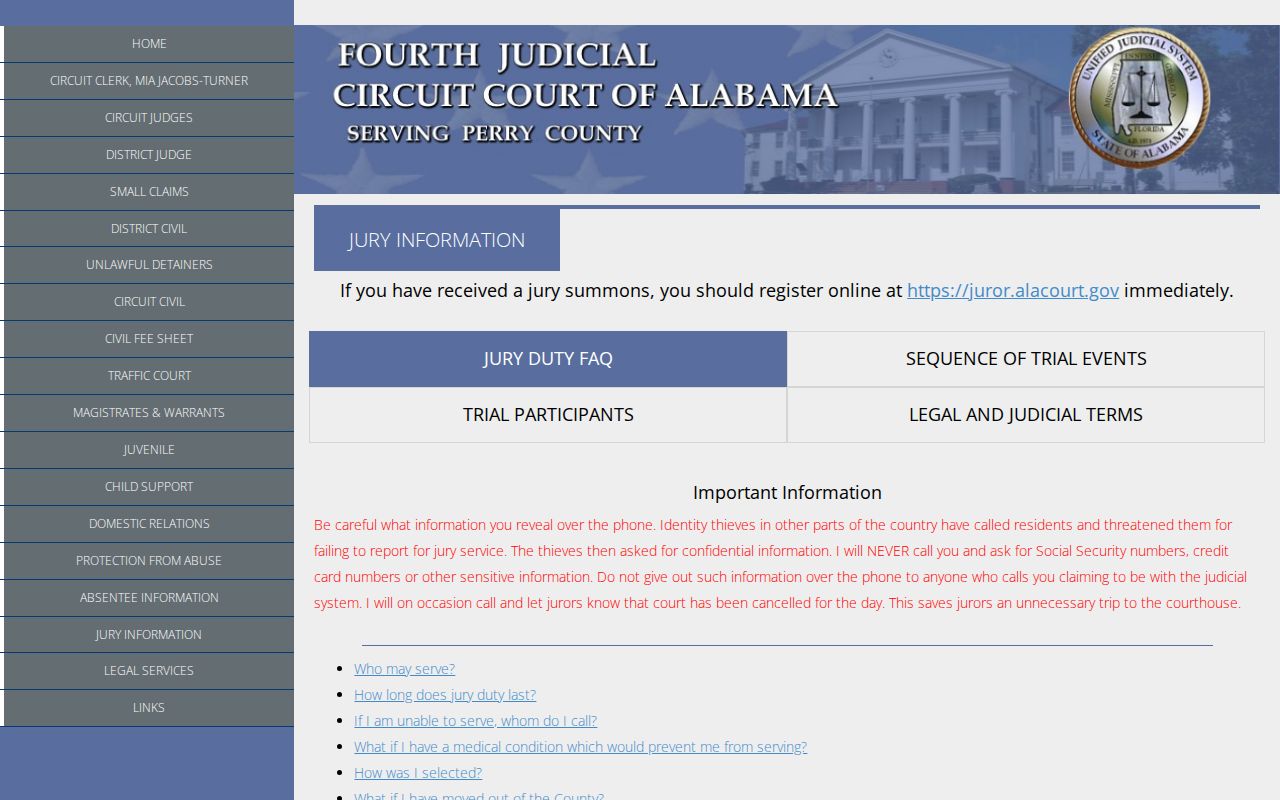
The Perry County Courthouse at 300 Washington Street is the place for court records and the Circuit Clerk. Hours run 8:00 a.m. to 4:30 p.m., Monday through Friday. Visitors pass a metal detector, weapons are prohibited, and parking around the building is free. The courthouse dates to 1855, and its white exterior and later wings are local landmarks, but the real reason to come is a court file, a traffic matter, or a clerk-directed process. The official Perry courthouse security page lays out the visitor rules and office hours worth checking before a records trip.
Start with a phone call. The jail and the Perry County Sheriff both sit at 202 Pickens Street. Next door, the Albert Turner, Sr. Courthouse Annex at 200 Pickens Street hosts county meetings, and it publishes no warrant counter of its own. No walk-in warrant window or after-hours bond schedule exists here either. Before you drive over, confirm which entrance you need, the current hours, what payment the office accepts, what identification to bring, and any accommodation arrangements. Adjacent county buildings are not interchangeable.
Handling a Perry County Warrant
Before you walk into any building on a Perry County warrant, make some calls first. Talk to the Sheriff and the issuing court. A lawyer can help too, especially one willing to coordinate a voluntary surrender. Ask practical questions early: where a surrender starts, what bond conditions apply, and when the first appearance happens. Perry County promises nothing on paper here. There is no guaranteed walk-through, no same-day release, no posted bond-window schedule, and no flat warrant amount that fits everyone. Expect that an active warrant can mean booking, with a judge deciding release. And keep the pieces straight: posting bond settles custody only, never the charge itself. After a missed court date, the judge might demand payment, a new date, a motion, or your presence in person before recalling the warrant. Hold on to every receipt, and get direct word that the warrant or ALEA hold is truly cleared.
Important: Speak with a lawyer before surrendering. An in-person warrant inquiry may lead to arrest when active process is confirmed.
Perry Traffic FTA Chain
A traffic problem in Perry County usually starts with a UTC and a court date, not a broad warrant database. Some tickets can be paid or resolved through the Alabama Traffic Service Center, which asks for the ticket number and date of birth. Depending on the case, that interface may let you upload proof, take defensive driving, buy more time, or ask for a new date. The Circuit Clerk cannot grant a continuance, though. That request goes to the judge in writing, with the case number on it. Skip the date or the payment and things can spiral. An alias warrant may issue, and a license suspension can follow without any advance notice. Remember what these tools are: the statewide traffic service and Alabama Pay resolve tickets, but using them proves nothing about other criminal warrants. Once you finish an eligible requirement, ask the clerk whether the court sent a clearance letter to ALEA and whether any appearance is still owed.
Read Perry Warrant Terms Carefully
Watch the wording in Perry County. Terms that sound alike can mark very different stages of the process. A records clerk may want the case number and warrant type before answering anything, and a payment portal may speak in ticket language while your real worry is an alias warrant. Use the issuing office's exact terms. Then ask what the status means today.
- Alias warrant
- Perry's published traffic term for arrest process that may follow failure to appear or pay; Alabama form C-65a uses “Alias Warrant of Arrest for Failure of Defendant to Appear.”
- Bench warrant
- Process issued by a judge for a missed setting, contempt, order violation, or comparable court noncompliance.
- UTC
- The Alabama Uniform Traffic Ticket identifier used by traffic resolution and payment systems.
- Return
- The serving officer's report to the issuing court describing when and how the warrant was executed.
- Recall
- An issuing court's withdrawal of a warrant; payment alone should not be assumed to create a recall.
- Initial appearance
- The post-arrest judicial proceeding addressing notice, counsel, release, and the next case step.
Warrant Record Access Under Alabama Law
Alabama's Open Records Law does open public writings, yet it cannot turn confidential or operational material into a public warrant list. Perry County's own more specific rule sets the starting line: an arrest warrant stays non-public until served. Some files may simply stay closed, including juvenile, youthful-offender, sealed, protected, and sensitive law-enforcement records. Ask the record custodian for a releasable copy instead of assuming every filed detail must be produced.
Key Rules:
Alabama Open Records Law, Ala. Code § 36-12-40 - Alabama citizens may inspect and copy public writings subject to legal exceptions.
Ala. Code § 12-15-133 - juvenile court and law-enforcement records are generally confidential.
Ala. Code § 15-19-7 - youthful-offender records receive confidential treatment.
Bond Does Not End the Case
Alabama Rule of Criminal Procedure 7.1 sorts release into distinct boxes: personal recognizance, appearance bonds, secured appearance, cash or certified funds, and surety. Rule 7.2 and its amended schedule add a statewide framework. Neither one sets a single Perry County amount for every warrant. What controls instead is the actual charge, any existing holds, prior release conditions, and the judge's findings. Perry County's public sources post no jail bond-window hours, no accepted-payment list, and no local bondsman directory. So ask before you gather funds. The Sheriff or the issuing court can give the current amount, the bond type, the payee, the location, the ID requirement, and whether some other hold still blocks release. Understand what a bond is: it buys release from custody and promises a later appearance. It does not erase the charge, settle a ticket, or cancel future settings. Miss the next date and you risk forfeiture plus new process, so write down the court, the date, and the case number before you leave.
Marion and Uniontown Split the Route
Marion and Uniontown are the only incorporated municipalities in Perry County. That split matters for routing. A city ticket or ordinance case stays with that municipal court, while a county crime, a county traffic case, or an unserved county arrest warrant follows the county channel. Marion Municipal Court meets at City Hall and posts its own payment guidance. Uniontown offers a city General Court ticket and case portal. Neither city publishes a public warrant roster.
| Matter | First Local Office | County Fallback |
|---|---|---|
| Marion ordinance or city traffic | Marion Municipal Court, (334) 683-8969 | Perry Sheriff for county process |
| Uniontown ordinance or city traffic | Uniontown Municipal Court, (334) 628-2011 | Perry Sheriff for county process |
| County criminal or unserved arrest warrant | Perry Sheriff, (334) 683-6534 | Circuit Clerk for court records |
City Warrant Records in Perry County
A city-level warrant check in Perry County starts where the case lived: the municipal court and the police agency that handled it. Marion and Uniontown municipal courts can issue process tied to city ordinances, municipal traffic citations, and failures to appear. Their files sit apart from Circuit and District Court records, even when city police or the Sheriff execute the warrant.
Marion Warrants
3,176 (2020 Census) · Municipal court and police routes for city traffic, ordinance, and FTA matters.
Uniontown Warrants
2,107 (2020 Census) · Front Street court, police, and ticket-portal routes for Uniontown matters.